

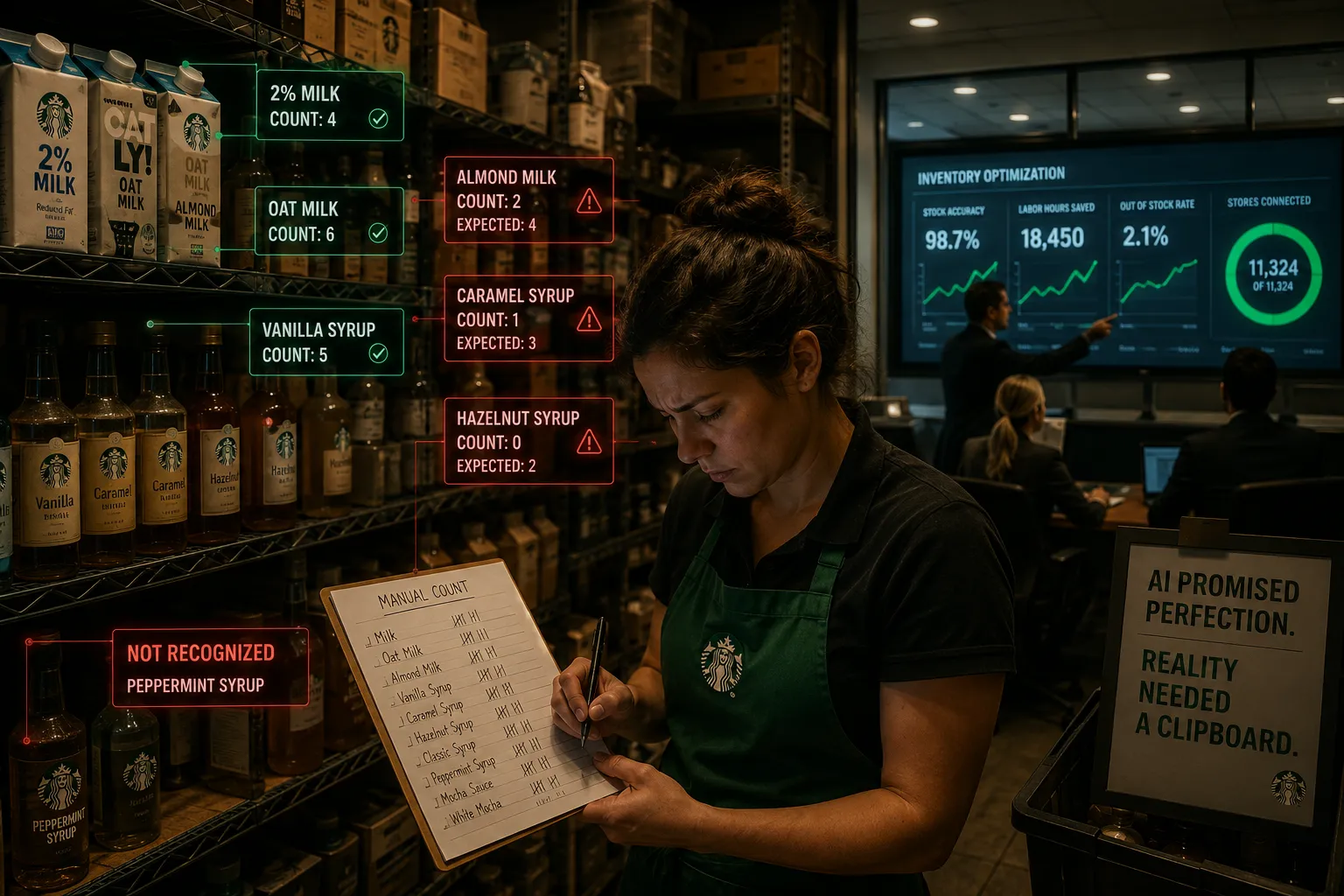

Starbucks AI Inventory System Failure. The Newsletter Nobody Outside Starbucks Was Supposed to Notice
Major corporate technology failures usually come with explanations.
Sometimes there is an earnings call. Sometimes, an executive interview. Sometimes a carefully crafted statement explaining why a strategic pivot became necessary.
Starbucks offered none of those.
Instead, the end of one of the company’s most ambitious AI initiatives arrived through a brief internal newsletter distributed to employees on May 19.
“Starting today, Automated Counting will be retired.”
That was it.
No celebration of lessons learned. No discussion of what went wrong. No announcement that a technology once presented as a key component of Starbucks’ operational turnaround had failed to meet expectations.
Just a quiet instruction to return to the old way of doing things.
For thousands of baristas across North America, it meant going back to manually counting milk cartons, syrups, beverage bases, and other inventory items. For everyone else, it raised a more important question:
How does a technology deployed across more than 11,000 stores survive less than a year?
The answer says as much about the current AI boom as it does about Starbucks.
A Problem Worth Solving
When Brian Niccol took over as CEO, Starbucks wasn’t struggling because people had stopped buying coffee.
The company faced a more frustrating challenge.
Customers were walking into stores only to discover that ingredients for their preferred drinks weren’t available. Certain syrups were missing. Alternative milk options had run out. Seasonal beverages advertised on menus couldn’t always be made.
Individually, these incidents seemed minor.
Collectively, they represented something much larger: a breakdown in operational consistency.
For a brand built on delivering the same experience whether you’re in Seattle, Chicago, Toronto, or Miami, inventory reliability is not a back-office function. It is part of the product.
Fixing that problem became a priority.
And like many large companies searching for efficiency in the age of artificial intelligence, Starbucks turned to technology.
The Promise
The Automated Counting system was developed alongside Seattle-based startup NomadGo and combined several technologies currently dominating boardroom conversations.
Computer vision.
LiDAR scanning.
Spatial intelligence.
Augmented reality.
Machine learning.
Using a mobile device, employees could scan shelves and storage areas while the software automatically identified products and calculated inventory levels. NomadGo claimed the system could perform counts up to eight times faster than traditional methods while maintaining accuracy levels approaching 99 percent.
On paper, the proposition was compelling.
Workers would spend less time counting.
Managers would gain better visibility into shortages.
Supply chains would become more responsive.
Customers would encounter fewer out-of-stock items.
Investors would see evidence that Starbucks was embracing AI-driven transformation.
Everyone appeared to win.
At least in theory.
“Technology should remove friction from operations. The moment employees spend more time verifying the technology than doing the task itself, the equation starts to reverse.”
When the Store Meets Reality
Retail stores are messy environments.
Boxes get moved.
Labels become damaged.
Products are stacked in unusual places.
Lighting changes.
Employees improvise storage solutions during busy periods.
Anyone who has worked in operations understands that reality rarely resembles a controlled demonstration.
This is where many AI systems encounter their first serious challenge.
According to employee reports, Starbucks’ inventory platform struggled with exactly the kinds of situations that occur daily inside real stores. Similar products were confused. Certain items were misidentified. Some inventory was counted incorrectly while other products were missed altogether.
One of the more remarkable details emerged from Starbucks’ own promotional material.
A demonstration video released during the launch reportedly showed the software failing to recognize a peppermint syrup bottle while successfully identifying nearby products. The issue wasn’t uncovered months later by critics. It appeared during the company’s own showcase.
Viewed in hindsight, it was an early warning sign.
The technology worked well enough to impress executives.
It didn’t work consistently enough to earn the trust of employees.
And in operational systems, trust matters more than presentations.
The Hidden Cost of Being Slightly Wrong
The problem with inventory management isn’t that mistakes happen.
The problem is that small mistakes travel.
If a store reports having more inventory than it actually possesses, replenishment orders may never be triggered. Products run out sooner than expected. Customers encounter unavailable menu items.
If inventory is undercounted, the opposite occurs. Supply chain forecasts become distorted, additional stock gets shipped unnecessarily, and inefficiencies begin accumulating elsewhere.
What makes these errors dangerous is their scale.
A miscount in one store is an inconvenience.
A miscount repeated across 11,000 stores becomes a systemic problem.
This is where many AI discussions become disconnected from operational reality.
Executives hear “99 percent accurate.”
Operations teams hear “one percent failure.”
At enterprise scale, those are two very different numbers.
Data Snapshot
Starbucks Automated Counting
- Launched: September 2025
- Retired: May 2026
- Deployment: 11,000+ stores
- Claimed Accuracy: 99%
- Core Technology: Computer Vision + LiDAR + Spatial Intelligence
- Objective: Reduce stockouts and labor hours
- Outcome: Retired after nine months
The Decision Behind the Decision
The real story here is not that the software struggled.
Every new technology struggles.
The more interesting question is why Starbucks deployed it so broadly before its limitations became apparent.
One possible explanation is that companies today face immense pressure to demonstrate AI adoption. Investors want to hear about artificial intelligence. Boards want transformation strategies. Competitors are announcing new AI initiatives almost weekly.
In that environment, deploying technology can begin to feel like progress in itself.
But technology deployment and problem solving are not the same thing.
A successful pilot proves potential.
A successful rollout proves reliability.
The distance between those two milestones is often much greater than executives expect.
What Happens Next?
Starbucks has not abandoned artificial intelligence. In fact, the company continues to expand Green Dot Assist, its generative AI platform built on Microsoft’s Azure OpenAI infrastructure.
That makes this story particularly important.
The company still believes technology can improve operations.
The difference is that one AI system has now demonstrated the cost of placing automation at the center of critical business decisions before it has earned operational trust.
Whether other retailers draw the same lesson remains to be seen.
Many are pursuing similar inventory, forecasting, and supply chain initiatives. Some may be experiencing comparable challenges without publicly discussing them.
What happened inside Starbucks could ultimately become remembered not as an isolated failure, but as one of the first large-scale reality checks of the enterprise AI era.
Blueprint Diaries Take
The easiest way to misunderstand this story is to call it an AI failure.
It wasn’t.
It was a leadership lesson.
The technology promised to eliminate a repetitive task. Instead, employees found themselves checking the software’s work while still performing their own. In practice, the machine became another thing requiring supervision.
That distinction matters.
Because the future belongs neither to companies that blindly embrace AI nor to those that reject it.
It belongs to those that understand where automation creates trust and where it merely creates the illusion of control.
Starbucks spent nine months learning the difference.
Its baristas appear to have figured it out much sooner.
Key Takeaways
• AI accuracy claims become far more consequential at enterprise scale.
• Operational trust is earned on the store floor, not in product demonstrations.
• A 1% error rate can become a major business problem when multiplied across thousands of locations.
• Technology should adapt to operations whenever possible, not force operations to adapt to technology.
• The biggest risk in AI adoption may not be failure. It may be deploying at scale before understanding where failure occurs.