
For the last twenty years, the consumer electronics industry operated on a simple, highly predictable rule: design it in California, build it in Shenzhen. That era is officially ending.
Reports this week indicate that Google is planning to completely halt Pixel production in China by 2027, shifting its manufacturing base primarily to India. They are essentially following Apple’s supply chain playbook, but operating on a much more aggressive timeline.
Shiprocket’s stock market debut has all the ingredients of a classic technology IPO success story. Shares opened at ₹142 against an IPO price of ₹97, giving the company an opening gain of roughly 46 percent. The ₹1,617 crore issue had already attracted extraordinary demand, being subscribed nearly 99.4 times. On the surface, it is another Indian technology company receiving a strong vote of confidence from public market investors.
But the more interesting story is not the opening price. It is what investors appear to be betting Shiprocket can become.
From Shipping Platform to Commerce Infrastructure
Shiprocket started by solving a fairly straightforward problem for online sellers. Instead of a small merchant having to manage multiple logistics companies independently, the platform could bring those services together through technology. That proposition made sense when India’s e commerce ecosystem was becoming increasingly fragmented and thousands of small businesses were beginning to sell online.
The opportunity today is considerably bigger. A modern Indian merchant may sell through a website, marketplaces, social media and messaging platforms simultaneously. They need logistics, payments, fulfilment, returns management, inventory visibility, customer communication and increasingly cross border commerce. The problem is no longer simply getting a parcel from one place to another. It is managing the entire commercial operation behind that parcel.
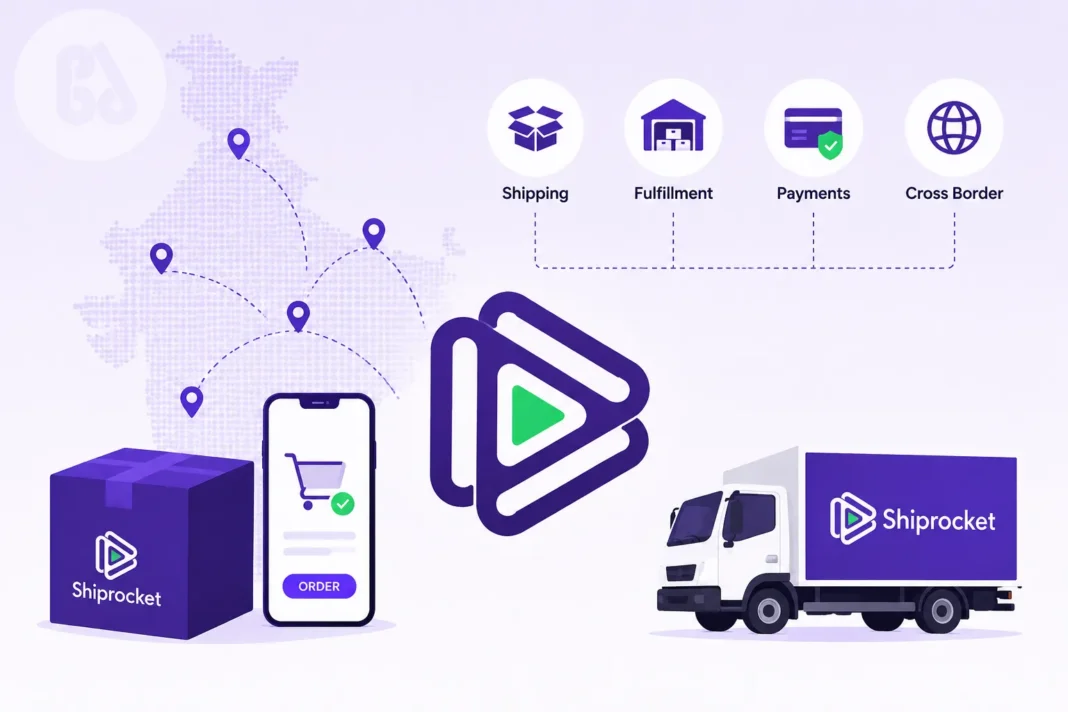
That is where Shiprocket becomes interesting. The company has been expanding beyond shipping into fulfilment, checkout, payments, marketing technology and cross border commerce. In effect, it is trying to move from being a logistics technology company to becoming a technology layer that sits underneath the broader commerce ecosystem.
That distinction could ultimately determine how valuable the business becomes.
India’s Next Digital Opportunity May Be the Merchant
For the last decade, much of India’s digital economy has been built around the consumer. We have watched consumers move from cash to digital payments, from physical stores to marketplaces and from traditional media to digital platforms.
The next phase may look very different.
The opportunity increasingly lies in helping businesses operate digitally.
India has millions of small and medium businesses that do not have the resources to build sophisticated technology infrastructure themselves. They do not want ten different software systems for ten different operational problems either. They want a relatively simple way to manage orders, payments, inventory, shipping and customers.
This creates an interesting category of businesses that can become infrastructure for other businesses.
And infrastructure businesses can become extremely powerful when they sit close to the daily transaction.
The Numbers Are Where the Story Gets Complicated
There is, however, a reason to remain cautious about the enthusiasm surrounding Shiprocket.
The company’s operating revenue grew around 24 percent in FY26 to approximately ₹2,024 crore, but the business continued to report a net loss of roughly ₹79 crore. Growth is clearly happening, but profitability has not yet become the defining characteristic of the company.
That creates the central question for public market investors: can Shiprocket grow its ecosystem faster than it grows its costs?
This matters because adding products is not automatically the same as creating a better business. A company can add payments, fulfilment, marketing and cross border services and still struggle to generate attractive margins if every new service brings additional operational complexity.
The real opportunity lies in something more powerful: increasing the amount of revenue and profit generated from each merchant relationship without proportionately increasing the cost of serving that merchant.
If Shiprocket can achieve that, the economics of the business could change considerably.
The “Operating System” Opportunity
We often describe companies such as Shiprocket as logistics platforms because that is where the story began. But that description may eventually become too narrow.
The more ambitious opportunity is to become an operating system for digital commerce.
The merchant should not have to care which courier ultimately delivers an order. They should not have to manually reconcile every payment. They should not have to build a separate technology stack to sell internationally. Ideally, the platform handles those complexities behind the scenes while the merchant focuses on selling.
This is where the real strategic value lies.
The company that controls that layer does not necessarily need to own trucks, warehouses or storefronts. It needs to own the technology that coordinates the ecosystem.
That is a fundamentally different business model from traditional logistics.
But Infrastructure Comes With Its Own Risks
There is also a danger in becoming infrastructure.
Once a platform becomes essential to thousands of businesses, those customers become increasingly sensitive to pricing, reliability and service quality. Merchants want more functionality but they also want lower costs. That creates a constant tension between expansion and profitability.
Shiprocket also operates in a market where competition is not standing still. Established logistics companies are becoming more technology driven, while large commerce platforms continue to develop their own fulfilment and logistics capabilities.
The company therefore cannot simply assume that a large merchant base will automatically translate into long term pricing power.
The bigger challenge will be demonstrating that its expanding product ecosystem genuinely increases customer lifetime value rather than simply adding more services to the same customer.
The Bigger Lesson for Indian Entrepreneurs
There is a broader lesson here that extends well beyond Shiprocket.
Some of India’s most interesting technology opportunities may not come from creating another consumer facing application. They may come from solving the operational problems that millions of existing businesses experience every day.
Inventory management is not particularly glamorous. Neither are reconciliation, compliance, fulfilment, returns or cross border documentation. Yet these are precisely the problems that become increasingly valuable as businesses digitise.
We have already seen this happen with payments. Digital infrastructure transformed the way businesses collect money. Logistics technology is transforming how products move. The next opportunity is connecting these fragmented layers into integrated business infrastructure.
The winners could be the companies that make complicated business operations feel remarkably simple.
Blueprint Diaries View
Shiprocket’s IPO debut is impressive, but the 46 percent opening gain is not what we should be watching.
The real story is whether the company can evolve from a logistics technology provider into an indispensable commerce infrastructure platform for India’s enormous base of small and medium businesses.
If it can increase the number of services used by each merchant, deepen those relationships and simultaneously improve its unit economics, the company could eventually justify a valuation far beyond what a conventional logistics business would command.
If revenue grows but profitability remains elusive, however, the market’s current enthusiasm could look very different a few years from now.
The IPO therefore gives us an interesting question to watch, not an answer.
Can Shiprocket become indispensable to India’s merchants while becoming more profitable at the same time?
That is far more important than where the stock opened today.